GraphQL Service
As businesses increasingly rely on data-driven applications, the need for efficient and flexible APIs has never been greater to share information and business services. That’s where GraphQL comes in.
Is GraphQL for you?
As businesses increasingly rely on data-driven applications, the need for efficient and flexible APIs has never been greater to share information and business services. That’s where GraphQL comes in.
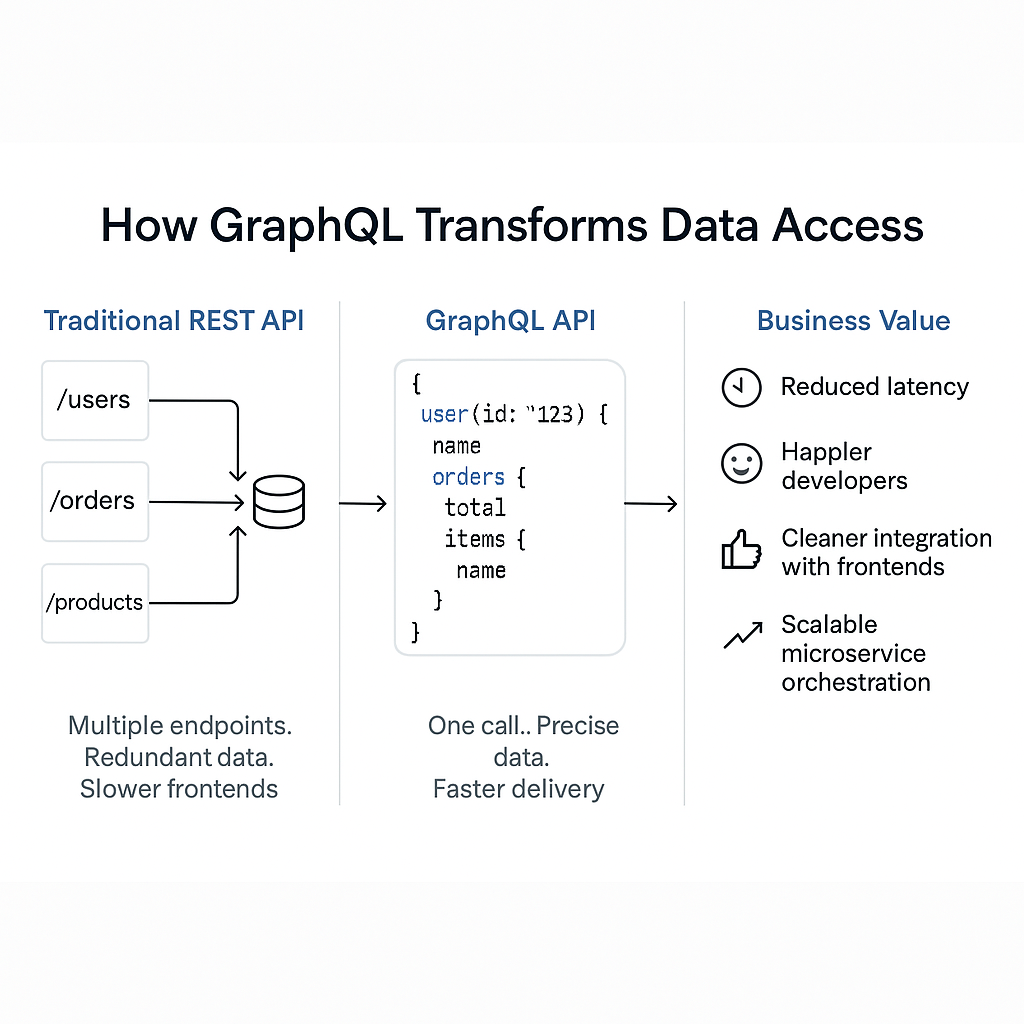
GraphQL is a modern open-source API query language that allows clients to request exactly the data they need — no more, no less. It flips the traditional REST model on its head by giving power to the consumer, enabling faster, more flexible, and more efficient data retrieval.
Whether you’re building customer-facing portals, mobile apps, or complex digital platforms, GraphQL provides a single, unified entry point to your data — streamlining the way your systems communicate.
What Are GraphQL's Capabilities?
GraphQL’s strengths lie in its precision, adaptability, and developer-friendly architecture. Key capabilities include:
- Flexible Queries: Clients can request exactly what they need, reducing over-fetching and under-fetching of data.
- Single Endpoint: Unlike REST, GraphQL uses a single endpoint, simplifying integration and versioning.
- Strongly Typed Schema: The schema defines all possible queries and types, ensuring consistency and reliability.
- Real-Time Data with Subscriptions: Enables reactive data flows through WebSockets — ideal for real-time features like notifications or live updates.
- Introspective & Self-Documenting: Built-in tooling makes GraphQL APIs easy to explore, test, and maintain.
It’s an ideal solution for organisations aiming to modernise their APIs and improve performance across digital touchpoints.
What are the benefits of using GraphQL?
GraphQL bridges the gap between data complexity and user experience — making it an ideal foundation for scalable, flexible, future-ready digital platforms.
Performance & Efficiency
- Fetch exactly what you need – no more, no less. Avoid over-fetching or under-fetching data, improving both backend performance and frontend responsiveness.
- Single API call – retrieve multiple resources in one go, even across deeply nested relationships. Perfect for complex systems and microservices.
Developer Productivity
- Tailored requests – front-end teams define the structure of the response, speeding up development and iteration cycles.
- Strong typing & introspection – GraphQL schemas serve as live documentation and validation tools, keeping everyone on the same page.
- Code reuse & sharing – standardised query patterns mean less duplication and cleaner, more maintainable code.
Scalability & Future-Proofing
- API evolution without versioning – new fields and types can be added without breaking existing queries.
- Schema-first design – ensures a consistent, governed approach to exposing services, even when your backend is stitched together from multiple sources.
GraphQL primary operations
GraphQL creates a schema to describe all the possible data that clients can query through the service. A GraphQL schema is made up of object types, which define its fields as well as the type of object you can request.
As queries come in, GraphQL validates the queries against the schema. GraphQL then executes the validated queries.
The API developer attaches each field in a schema to a function called a resolver. During execution, the resolver is called to produce the value.
Based on the graph data modelling with the schema at its core, GraphQL has three primary operations:
Query
Send a query to your API and get exactly what you need, nothing more and nothing less, in a single API call.
Mutation
Write GraphQL APIs that work with your existing data and code.
Subscription
Long-lived query that fetches data in response to source events.
GraphQL has a number of design principles
Hierarchical
Queries are structured like the data they return. This makes it easy to shape the data and write queries.
Product Centric
Language and runtime are built around the needs of front-end engineers and the views they create.
Strong Typing
Type generation libraries can take advantage of the strongly-typed nature of GraphQL schema to automatically generate TypeScript types based on that schema.
Client Specified Queries
Your application has complete control over the exact data it receives from the server by defining the specific fields it needs in its query. This ensures that it fetches only what is asked for and prevents unnecessary over-fetching.
Introspective
Introspection is a powerful tool that allows developers to query details about the GraphQL schema itself. This is essential for understanding the structure and capabilities of an API.
Spring Boot vs GraphQL – A Power Duo, Not a Rivalry
While Spring Boot and GraphQL serve different purposes, together they form a modern, high-performance application stack:
| Feature / Focus | Spring Boot | GraphQL |
| Primary Role | Backend application framework | API query language |
| Use Case | Building microservices, APIs, web apps | Serving client-defined data from APIs |
| Data Handling | RESTful endpoints (by default) | Flexible, single-endpoint data queries |
| Configuration | Auto-configured, convention over config | Schema-defined, introspective |
| Scalability | Horizontal scaling with microservices | Scalable queries and dynamic API federation |
| Best When | You need a reliable, production-ready backend | You want front-end flexibility and data efficiency |
| Integration | Can expose GraphQL APIs via Spring Boot | Consumes data from Spring Boot services |
Together: Use Spring Boot to build robust backend services, and GraphQL to expose them in a modern, flexible way. It’s the architectural equivalent of pairing a high-performance engine with a precision steering system.
How our GraphQL Service Works
At DeeperThanBlue, we help you unlock the full potential of GraphQL — not just as a technical tool, but as a business enabler. Here’s our approach:
1. API Strategy & Advisory
We start by assessing your current API landscape, identifying opportunities where GraphQL can reduce complexity, unify services, and accelerate performance.
2. Schema Design & Architecture
Our expert consultants craft well-structured, scalable GraphQL schemas that serve both current and future data needs — aligned to your domain model and digital objectives.
3. Implementation & Integration
Whether you’re starting from scratch or layering GraphQL over existing REST services, we handle the GraphQL development heavy lifting — including resolver logic, data federation, and security controls.
4. Tooling & Developer Enablement
We integrate modern dev tools (like Apollo, GraphiQL, or PostGraphile) and provide tailored training to empower your teams to work confidently with GraphQL.
5. Optimisation & Support
After deployment, we monitor performance, manage schema evolution, and fine-tune APIs for scalability, stability, and long-term success.
How DeeperThanBlue can help with GraphQL
Design & Architecture
Implementing best-practice approaches tailored to your specific requirements for GraphQL installations.
Build & Develop
Development and testing services, utilising agile methodologies to build high-quality software solutions based on GraphQL solutions.
Upgrades & Migrations
Ensuring your GraphQL investment is maintained and future-proofed.
Health Checks & Performance Reviews (APM/ SRE)
Ensuring that GraphQL environments are performing to service levels, and are up to date with application and security fix packs.
Support & AMS
Providing support and managed services offerings for GraphQL to meet your organisations business requirements and service.
How our GraphQL Services Have Helped Businesses Like Yours
GraphQL FAQs
1. What is GraphQL? +
2. What is GraphQL Vs REST API? +
3. How Can GraphQL Improve the Performance of My Application? +
4. Which Industries Could Benefit From Implementing GraphQL? +
5. Is GraphQL Suitable for Both Small and Large Applications? +
6. How Much Does It Cost to Implement GraphQL? +
7. Can GraphQL be Integrated With Existing REST Services? +
8. How Disruptive is it to Introduce GraphQL? +
9. How Does GraphQL Handle Complex Queries and Relationships? +
10. What Are the Security Considerations for GraphQL APIs? +
11. How Does GraphQL Support Real-Time Updates? +
12. Can GraphQL Be Used With Headless Architecture? +
13. How Does GraphQL Impact Development Time and Costs? +
14. Is GraphQL Suitable for Legacy Systems? +