Drive innovation with Gemini Enterprise Agent Platform and DeeperThanBlue
There's more to Google Cloud AI than meets the eye
Google’s approach to AI brings solutions to the fingertips of businesses and individuals, and at DeeperThanBlue, we help businesses harness the transformative potential of Google Cloud AI, including the cutting-edge capabilities of Google Gemini and Gemini Enterprise Agent Platform (previously known as Vertex AI). Whether you’re exploring AI for the first time or scaling existing solutions, our expertise ensures you unlock real business value.
The suite of AI applications available from Google is comprehensive, underpinned by a deep research pedigree and a robust ecosystem of products, platforms, and tools.
Google Cloud AI Suite
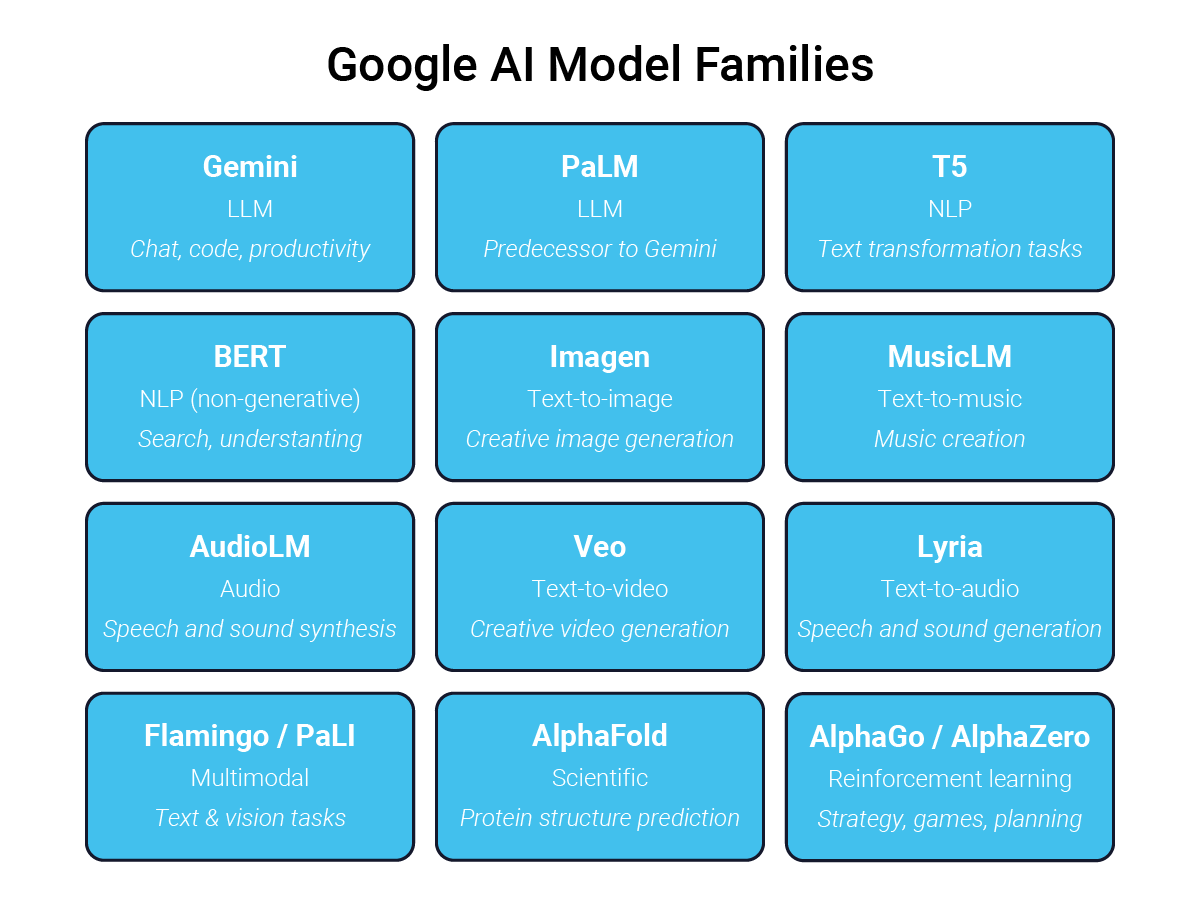
Gemini is Google’s flagship family of large language multimodal models that handles everything from natural language processing to creating content across different media types. These models are capable of understanding and generating text, images, audio, video, and code.
Gemini has essentially taken over from earlier models like PaLM, incorporating the latest breakthroughs from Google’s AI labs and DeepMind. You’ll find these models woven throughout Google’s offerings—Search, Gmail, Docs, Android, and Google Cloud—powering features like AI writing assistance, instant translation, and code generation. This isn’t just academic research; it’s AI that’s actually being used by millions.
Supporting Gemini is a suite of specialist models, each with their own functionality. BERT still does the heavy lifting for semantic search and language understanding, particularly in Google Search. Veo, Imagen (used to create the hero image on this page), MusicLM, and AudioLM/Lyria handle the creative side, generating video, images, music, and audio respectively. Then there are multimodal models like Flamingo and PaLI that can work across text, images, and video—the building blocks for truly versatile AI systems. At the cutting edge, DeepMind continues to push boundaries with game-changers like AlphaFold (which cracked protein folding) and AlphaZero (the strategic AI master).
Gemini is designed for flexibility and ease of use, supporting deployments across multiple environments-including multi-cloud and on-premises-making it ideal for businesses seeking agility and avoiding vendor lock-in. Moreover, it integrates easily with existing software stacks, including Salesforce, Trello, and Asana.
The latest version of the Google Gemini family is 2.5, designed for enterprise-grade performance and flexibility. The main variants include:
- Gemini 2.5 Pro: A powerful model for complex reasoning, multimodal understanding, and high-quality content generation. It supports text, image, audio, and video inputs, making it ideal for advanced enterprise use cases like document analysis, media summarisation, and intelligent agents.
- Gemini 2.5 Flash: A high-speed, cost-efficient model optimised for real-time applications. It offers enhanced performance over 1.5 Flash and supports multimodal inputs, function calling, and live API interactions. It’s ideal for chatbots, summarisation, and fast content generation.
- Gemini 2.5 Flash-Lite: A lightweight version of Flash, designed for ultra-low-latency tasks with minimal compute requirements. Best suited for mobile and edge deployments or high-volume, low-complexity tasks.
Vertex AI
Gemini Enterprise Agent Platform is a vital part of Google’s AI hierarchy, but it’s not a model itself. Instead, it acts as the platform layer that gives developers and enterprises access to Google’s models, tools, and infrastructure. It is a unified platform for building, deploying, and scaling machine learning and generative AI models. Think of it as the operational hub where everything AI-related within Google Cloud comes together.
In the hierarchy, Gemini Enterprise Agent Platform sits just below the model layer (like Gemini, Imagen, PaLM, etc.) and above the application or deployment layer. It allows users to build, customise, deploy, and manage machine learning models at scale. You can fine-tune Google’s foundation models (like Gemini Pro or Imagen), run your own custom models, or even integrate open-source ones—all within a unified environment. It also provides MLOps capabilities (pipelines, model monitoring, versioning, etc.), making it particularly powerful for production-grade enterprise use.
In short, Gemini Enterprise Agent Platform is the delivery engine—the platform that makes Google’s models usable in the real world by developers, data scientists, and businesses. It’s how Google’s AI is productised and made available to the public outside of its own first-party apps like Gmail or Search.
There are three components of Gemini Enterprise Agent Platform:
- Agent Builder: Create intelligent, task-specific agents using natural language prompts—ideal for customer service, HR, and IT automation.
- Model Builder: Train and fine-tune custom models using your own data, with support for AutoML and custom training.
- Model Garden: Access a curated library of pre-trained models, including Gemini, open-source models, and third-party offerings.
Why Choose DeeperThanBlue for Google Cloud AI?
With over 20 years’ experience in IT and digital transformation, DeeperThanBlue delivers tailored AI solutions that align with your business goals. We help you navigate the complexities of Google Cloud AI, from strategy and integration to ongoing support.
Ready to explore Google Gemini and Gemini Enterprise Agent Platform for your business? Contact DeeperThanBlue today to start your AI journey.
+44 (0)114 399 2820
info@deeperthanblue.com
Get in touch
Google Cloud AI FAQs
1. What is Google Cloud AI? +
2. How can Google Cloud AI be integrated into my business? +
3. Where could I use Google Cloud AI? +
4. How much does Google Gemini and Google Cloud Vertex AI cost? +
5. What is a token? +
6. How does Google Cloud AI ensure the security of business data? +
7. How does Google Cloud AI handle data privacy and compliance? +
8. Can I bring my own machine learning model to Google Cloud? +
9. How do I get started with Google Cloud AI? +