One thing I’ve noticed in recent weeks (and something that irritates me perhaps more than is should) is the way people confidently throw the phrase ‘AI Agent’ into conversations, presentations, and content, when what they are referring to is in no way agentic. Chatbots have become agents. Assistants have become agents. Even a single button that fires off one API call has become an agent.
The word is doing a lot of heavy lifting it hasn’t earned.
When an everyday household name like Microsoft uses ‘agent’ to describe Copilot Chat agents, in-app Copilot tools, and Azure AI agents, this muddies the waters for everyone.
I don’t think I’m being pedantic. This ambiguity can potentially be damaging both to businesses purporting to deliver AI agents and to those investing large sums of money into technology.
If a business buys “agentic AI” expecting autonomous, multi-step execution and gets a glorified chat window instead, the mismatch will rear its ugly head very quickly, soon to be followed by disappointed stakeholders, unmet ROI expectations, and a governance gap nobody planned for.
Getting the terminology right isn’t about being precious with language. It’s about buying, building, and deploying the right thing for the job.
To help with this I’d like to help untangle three terms that get used almost interchangeably but describe genuinely different technologies: generative AI for personal productivity, AI assistants, and AI agents / agentic AI.
Three terms, one blurry vocabulary
Don’t get me wrong, I’ve got nothing against chatbots (that work), AI assistants and everyday productivity tools. I freely admit that I use tools like Claude, ChatGPT, Gemini, Perplexity and Copilot every day. But if we deploy a generative AI solution to do a particular task or set of tasks, please can we use the right terminology, rather than overstating its capability?
Generative AI for personal productivity
This is the foundational layer of generative AI. Large language models (LLMs) and large multimodal models (LMMs) that produce novel content based on a user’s prompt. It is reactive by design; you ask, it answers. And with no further user input, nothing else happens. There’s no lasting memory of your goals (unless you return to an answer and re-prompt), no independent action, no capacity to go and do something in the world on your behalf. Simply put, it creates; it doesn’t execute.
AI Assistants
A level up from LLMs/LMMs sit AI Assistants. Fundamentally, they are still conversational and still need you to prompt them to initiate each step. Where they differ is that they carry context, they live inside your existing tools and can call on a limited set of functions to help you get something done. For example, you might have used Copilot to summarise your inbox, or you might have assistants that can search a knowledge database that you’ve given it access to or perhaps draft a briefing from your CRM data. So, while the assistant makes these processes notably faster, the human is firmly in the loop and remains in control. It takes the grunt work out of predictable tasks.
AI Agents/Agentic AI
The key feature of true agents is autonomy. An agent (or an agentic system of several coordinating agents) is given a goal rather than a single instruction – you tell it what you want the outcome to be and the agent plans, sequences, and executes the steps needed to reach that goal. It will call tools, retrieve data and make decisions about what to do next, often looping through several rounds of reasoning before a human ever sees the result. The autonomy means that the agent is given the agency to make contextual decisions rather than simply responding to a prompt.
Where each approach is best suited
| Generative AI | AI Assistants | AI Agents | |
| Best suited for | One-off content creation: drafting, ideation, summarising, image or code generation | Day-to-day task support inside a tool you already use, where you make the final call | Multi-step, rules-bound processes that would otherwise need a person to babysit every stage |
| Human role | Prompts, then owns every output | Prompts and reviews, but stays in the driving seat throughout | Sets the goal and guardrails, then reviews by exception |
| Risk profile | Informational — hallucination, bias, inaccurate content | Informational, with limited operational exposure via connected tools | Operational — autonomous actions on live systems, data, and workflows |
| Typical cost / latency | Low — a single inference call | Low to moderate | Higher — many chained calls per task |
Why should you choose Agents over anything else?
The answer to this is that you probably shouldn’t. Each should be judged on its own merits. Horses for courses, as they say.
Generative AI for personal productivity is fast, cheap, and endlessly flexible for anything creative or exploratory — first drafts, brainstorming, code scaffolding, image concepts. Control remains in the user’s hands, which is exactly how it should be when judgement, brand voice, or nuance matters more than speed. Take the human element out and you end up with AI slop.
AI assistants reduce the cognitive load of switching between systems. They carry context and operate within the tools people already use; they cut down on repetitive typing and searching without asking anyone to hand over control of a process. They’re the natural way for organisations to build their AI experience while building trust in the potential of AI-assisted work.
AI agents earn their keep on volume and consistency. Once a process is well-understood and rules-based enough to define clear guardrails, an agent can run it continuously, at scale, with far less manual handling, so people are freed up to deal with exceptions that genuinely need a human.
Real-world Examples
| Generative AI | AI Assistants | AI Agents |
| You use a descriptive prompt to get Claude or ChatGPT to create a first draft of a blog post, or variations to marketing copy depending on the target audience, Claude Code or Codex to produce a code snippet based on your objective, or Midjourney or DALL-E to produce a concept for graphic design. | With Microsoft 365 Copilot embedded in Word, Excel and Outlook, users can receive meeting notes or actions immediately after a meeting and share with participants. For developers, and in-IDE coding assistant can suggest completions as they type. Businesses can develop Assistants that live over enterprise data (unstructured) and applications (transactional) to provide increased levels of self service in a secure and governed manner. |
Agents in Copilot Studio or Azure AI can read incoming invoices and match them to purchase orders. They can then release payments automatically escalating only exceptions. A customer service Agent can manage an entire conversation pulling data from backend systems without a human triggering each step. The Agent will also decide when to escalate the call to a human call handler. |
Where the lines genuinely blur.
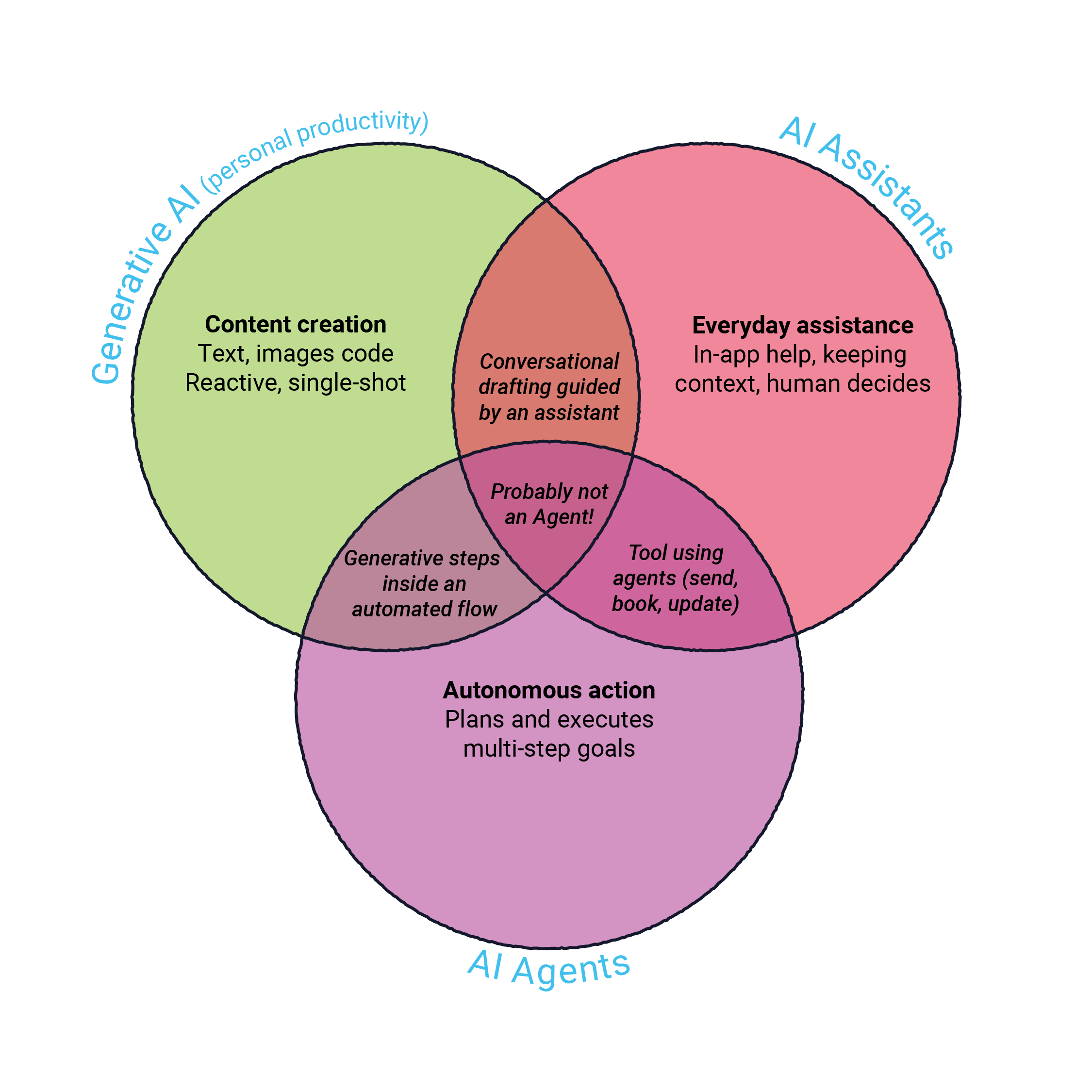
Having given clear definitions of these three AI concepts, I’ve got to admit that there is some degree of overlap (and perhaps where some of the confusion in terminology stem from). I like a visual, so here’s a diagram to show where each concept crosses over with others.
The intersections
Generative AI and Assistants
This overlap in real and unavoidable. An assistant does draft content generatively, but it’s just more aware of what you’re working on. Your AI assistants are basically a generative model wrapped in context and a bit of memory.
Assistants and Agents
This is where most of the confusion sits – when is an assistant actually an agent, and vice versa? When an assistant starts to access tools, they book meetings for you, update records or trigger a workflow. At this point they start to look like an agent. In some instances they are still just following instructions that have been predefined and the process isn’t autonomous in the true sense of the word. Microsoft’s own Copilot Chat agents are a good example of a product that has genuinely grown from assistant into something closer to an agent, which is part of why even Microsoft’s own documentation admits the terminology gets confusing fast.
Generative AI and Agents
This is only a slight overlap, but it does exist as agents still use generative models to produce its intermediate outputs, such as email drafts or summarised documents, but this is a just a small part of the agentic process. Agents can be generative, but generative AI isn’t agentic.
The murky middle – ‘the bandwagon zone’
Aaarrgghhh! My real bête noire! Where the three concepts meet is where the greatest confusion lies. Tools that sit in this zone are labelled as Agents, but in practice they are just single-step, human-initiated, generative functions with no persistent goal, no independent multi-step planning, no real autonomy — just an assistant with an agent-shaped name tag. STOP CALLING THEM AGENTS!!!
Why the label actually matters
“Calm yourself, Stephen. It’s not the end of the world!”
Yes, I know that’s the case, but the distinction is still important.
Generative AI and AI assistants carry informational risk, where the worst case is a wrong or biased answer that a human catches before it goes anywhere. Agentic AI on the other hand carries operational risk with autonomous systems acting on live data and live workflows, where the worst case is a wrong action, not just a wrong answer. That’s a governance conversation, not a features conversation: who’s accountable when an autonomous system makes a call, what data it could touch, and how far its permissions extend.
A Quick Test to Cut Through the Crap
Next time you catch yourself calling something an “AI agent,” ask yourself: are they actually deciding what happens next, or just waiting for your next prompt? Are they taking action, or only describing one? Are they working toward a goal across several steps on their own, or answering a single question very well and then stopping?
If the honest answer to those is “not really,” what you’ve got is a very capable assistant — which is no bad thing, just not the thing the name claims.
You’ll have seen these quizzes in lifestyle magazines, so test your use case here…
Three questions will tell you what you’re really looking at:
- Does it remember and build on state across multiple steps, or does each interaction start fresh?
- Does it take action (e.g. calling tools, updating systems, triggering processes) without you prompting each individual step?
- Does it decide what to do next itself, within a goal you set, rather than you deciding for it?
If you answer ‘No’ to all three, it’s generative.
‘Yes’ to number 1, but you are still initiating and approving each action, it’s an assistant.
‘Yes’ to all three: Hooray, you have an agent. I give you permission to use the word!
Everything else is a name tag borrowed from the technology everyone wants to be seen using.
A Note About Chatbots
When discussing AI Assistants and AI Agents, it’s important not to confuse them with traditional chatbots. While all three may interact through a conversational interface, their capabilities can be very different.
Traditional chatbots are typically rule-based and follow predefined scripts or decision trees. They are designed to answer common questions, provide information, or guide users through simple processes. Their responses are generally based on specific keywords, menu selections, or predetermined conversational paths rather than a deep understanding of context or intent. As a result, they are effective for handling repetitive enquiries such as FAQs, booking requests, account lookups, and basic customer support tasks.
Unlike AI Assistants, traditional chatbots generally cannot reason, learn from interactions, or carry out complex tasks across multiple systems. They are limited to the functionality they have been explicitly programmed to provide. AI Assistants can understand more natural language, maintain context, and generate responses dynamically, while AI Agents can go even further by making decisions, executing workflows, and autonomously completing multi-step processes to achieve an objective.
In simple terms, a chatbot follows a script, an AI Assistant supports a conversation, and an AI Agent takes action. Each has its place, but understanding the differences is essential when evaluating which technology is best suited to your business goals and customer experience requirements.
The takeaway
While I’m up here on my soapbox, I want to be clear that I don’t have anything against any of the technologies discussed here. None of the three is ‘better’ than the others; they solve different problems and can quite happily sit side by side in any AI strategy. While chatbots remain a valuable and cost-effective solution for many customer service scenarios, organisations looking to automate more complex interactions and business processes should consider whether an AI Assistant or AI Agent would deliver greater long-term value.
You should look towards using generative AI for creative and exploratory work, assistants for day-to-day support inside existing tools, and agents for the well-defined, high-volume processes worth automating end to end.
The risk isn’t in using any of them. It’s in mislabelling one as another, setting expectations, and even governance, for the wrong thing entirely.
Class dismissed.
These might interest you
Do you need an AI Agent, an AI Assistant, or something else entirely?
We can help you untangle the terminology and get the right tool for your use case. Drop us a line and we’ll arrange a call.
+44 (0)114 399 2820
info@deeperthanblue.com
Get in touch