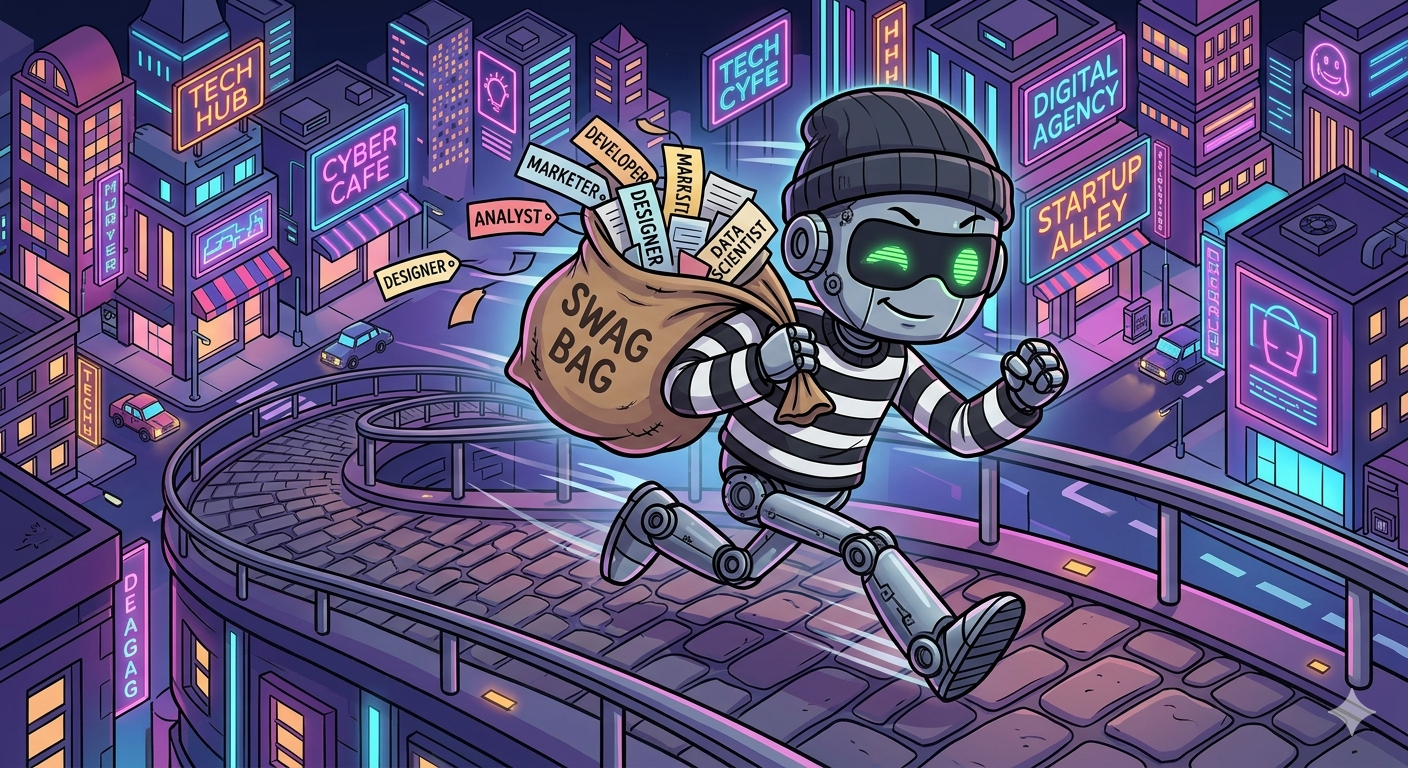
When AI started embedding itself in everyday parlance, major AI creators – OpenAI, Google, Anthropic, et al – largely downplayed the potential for large-scale job losses due to AI’s impact. However, below the surface, there were murmurings of possible disruption to the employment status quo.
By 2026, though, a divide in opinion has become apparent, with more nuanced and even contradictory opinions being aired. Three camps have emerged:
- Camp 1: “AI won’t replace jobs.”
- Camp 2: “Jobs will change massively, and some will disappear.”
- Camp 3: “This could be much worse than previous tech revolutions.”
Personally, I take a realistic and optimistic view of AI’s potential impact on business and employment – and hope this won’t come back to bite me on the bum!
The view in 2024: “AI will transform jobs”
This was seen as the official line from major AI developers and tech CEOs when AI first really grabbed the attention of business leaders and the media. Companies like Google, Microsoft and Meta framed AI as a powerful productivity tool to assist workers and not eliminate them.
Even then though, some leading figures warned AI could upend the jobs market with entry-level white-collar jobs especially at risk, though mainstream opinion held that AI would follow historical precedent: technology creating jobs with net-positive long-term effects.
Fast-forward to 2026: A more fragmented outlook
In 2026, the picture has evolved. Doomsayers claim AI will take over the world, while enthusiasts say AI will enhance everyone’s working lives forever. Those in the middle-ground have a more realistic take.
Camp 1: Everything is Awesome
Big tech CEOs still say AI won’t replace jobs, with the caveat that AI enables leaner teams. Jensen Huang of NVIDIA is optimistic, saying AI creates enormous numbers of jobs and offers the US its best opportunity to re-industrialise through data centres, chip manufacturing, robotics and infrastructure. Sam Altman of OpenAI promotes AI’s ability to augment employees, suggesting AI will make people busier rather than idle. AWS leadership says demand for IT engineers and developers continues growing, even with AI coding tools.
However, media reports increasingly link layoffs to AI’s impact. Mark Zuckerberg acknowledged that AI indirectly caused job losses at Meta, with the company focusing on AI infrastructure spending while recognising that AI enables leaner teams.
Camp 3: We’re Doomed
(Don’t worry, I’m coming back to Camp 2).
Persistent pessimists claim this technical revolution will be worse than previous ones. Writer Nathan Brunner published a 2026 piece citing a 2023 Goldman Sachs report, claiming generative AI could replace 270 million full-time jobs by 2030. This figure doesn’t appear in the Goldman Sachs report, yet Brunner published this misleading statistic. I’m purposely not linking to Brunner’s page, but you can search ‘Statistics on AI Replacing Jobs – Brunner’ if interested.
Publishing misinformation isn’t helpful; it fuels panic.
Camp 2: Changes are afoot
I’ve placed this out of sequence as I feel it’s the most rational view. Yes, AI will change how people work; it already is. Over the past year, AI has progressed beyond experimental stage to making notable differences in working practices, taking on routine administrative tasks and bringing automation many hadn’t considered two years ago.
Data from the Goldman Sachs report are more upbeat than Camp 3 suggests. On page 9, they state, “Although the impact of AI on the labor market is likely to be significant, most jobs and industries are only partially exposed to automation and are thus more likely to be complemented rather than substituted by AI.”
A 2026 Boston Consulting Group study suggests 50-55% of jobs in the US will be reshaped (not replaced) by AI in the next 2-3 years. Employees will retain similar roles, but expectations for how they work and what they produce will change significantly. They also suggest 10-15% of jobs could genuinely disappear over time.
There’s genuine risk AI will replace some jobs, particularly where work is routine, repetitive or standardised. But the more likely near-term outcome isn’t sudden mass redundancies. Instead, AI is accelerating task automation, reshaping roles and changing the balance between entry-level work and higher-value judgement, oversight and decision-making.
The technology develops at a rapid pace, and all but the largest enterprises with the deepest pockets and greatest resources will struggle to keep up. In the past, organisations could often absorb technological change over years or even decades. AI is compressing that cycle. Roles are being redesigned while firms are still working out where AI fits, which means the pressure on skills, management and training is arriving sooner than many workforces are ready for.
But the question that other business leaders should be asking is ‘how does my business adopt AI in a meaningful way?’.
The responsibility for change sits with us all
Every major industrial shift has disrupted labour markets. The difference this time is speed. The Stanford AI Index shows generative AI is now used in at least one business function by 70% of organisations. AI is moving from pilot projects into everyday business use far more quickly than previous technologies.
The Goldman Sachs report compared the current AI revolution to previous economic turning points, citing economist David Autor and co-authors: “60% of workers today are employed in occupations that did not exist in 1940, implying that over 85% of employment growth over the last 80 years is explained by the technology-driven creation of new positions”.
Satya Nadella from Microsoft compares AI to the birth of knowledge work in the PC era, leading to new job categories that never existed before.
The onus for change shouldn’t be placed solely on the shoulders of business leaders. The response to the AI challenge (or perhaps I should say, opportunity) should be shared by policymakers and educators as well to make sure that the workforce gains and maintains the knowledge and skills needed to perform in the new way of working. Educators need to embrace the technology and teach responsible usage. Policymakers must develop robust governance to protect businesses.
It is also incumbent on the individual to be willing to change. Jensen Huang has been quoted as saying, ‘You won’t lose your job to AI. You’ll lose it to someone using AI‘. I’m not suggesting that everyone should blindly accept AI replacing elements of their job. Any business introducing AI must prove its worth and demonstrate it to the users before they can expect these employees to accept the change. Indeed, involving these individuals in the implementation process is more likely to lead to buy-in than a ‘you will use AI’ three-line whip.
The Right Kind of Training
It’s not as simple as teaching generic AI skills. The Productivity Institute reports that valued skills vary by industry. Manufacturing and construction emphasise technical and occupational skills, while health, education and public services prioritise IT and digital skills, literacy and customer service. AI isn’t simply a technology problem; it’s an industry-specific workforce problem requiring different responses.
One of the most worrying trends is the effect on people at the start of their careers. The Stanford AI Index reports that employment for software developers aged 22 to 25 has fallen nearly 20% from 2024, and that employer surveys expect further workforce reductions. That does not mean every graduate will face a bleak future, but it does mean the first rung of the career ladder is under pressure.
This makes early-career development crucial. If AI removes traditional entry-level tasks, organisations must redesign talent development through structured apprenticeships, stronger mentoring, project-based learning and better progression pathways. Without this, we risk a skills bottleneck: businesses adopting AI faster than they build human capability.
If there is a practical lesson from the evidence, it is that training is the best defence against displacement. The Productivity Institute report found that AI is already being used to support lower-level tasks such as data recording, summarising information and proofreading. That suggests a clear shift: if routine work can be automated, then workers need to move towards interpretation, coordination, relationship management and decision support.
The report also shows that organisations are already responding with training, including supplier training, internal training and external providers. More broadly, employers cited productivity and retention as the main reasons for training, which tells us something important: training is no longer a nice-to-have; it is a business necessity. Firms that fail to invest in skills will not simply fall behind on AI; they will fall behind on productivity, talent retention and resilience.
Never Forget the Human in the Loop
Even as AI becomes more capable, human oversight remains essential. The Stanford AI Index notes that while adoption is strong, AI agents are deployed in fewer than one in ten instances across business functions, suggesting organisations are still early in embedding AI into full workflows. Humans still do final sense-checking, escalation handling and accountability work.
This is where experienced professionals become even more valuable. While AI can summarise, draft and classify, it still makes mistakes, misses context and struggles in situations where judgement is necessary. Experienced workers should not be viewed as legacy costs; they are the safeguard that makes AI useful and trustworthy. They also retain the traditional role of mentors to less experienced employees. While the latter are more likely to lean into the power of AI and what it can do for them, these experienced workers can help them challenge and interrogate the AI outputs rather than simply accept them without question.
In practice, the future is less “AI versus people” and more “AI with people”, with best outcomes where human expertise sits behind the machine.
A practical response
The right response to AI is not panic and it is not complacency. Businesses should treat AI as a transformation programme that demands new skills, revised workflows and clearer accountability. Schools and colleges should teach adaptability, critical thinking, digital confidence and the ability to work alongside intelligent systems. Employers should invest in reskilling the existing workforce and redesigning jobs so that AI removes drudgery rather than human value.
There is also a broader leadership point. AI adoption should not be measured only by cost savings or headcount reduction. It should also be judged by whether it improves productivity, quality, service and resilience while creating better jobs over time. That is a more sustainable strategy than trying to use AI simply to cut costs in the short term.
Closing argument
AI will replace some roles, but it will reshape far more. The businesses that succeed will be those that combine technology with judgement, automation with accountability and innovation with investment in people. The winners will not be the organisations that use AI to remove humans from the process, but the ones that use AI to make human work more valuable.
The message for leaders is clear. Train the workforce, support the next generation, keep humans in the loop and keep humans at the helm. AI may be faster than previous industrial shifts, but the principle remains the same: technology delivers its greatest value when people are prepared to adapt with it.
These might interest you
Agentic AI: What is it and How Can it Benefit Businesses?
Chatbots are evolving, drawing on advanced AI capabilities to become AI Agents – fully autonomous, sophisticated systems capable of advanced Read MoreCrafting a Robust AI Strategy: A Practical Guide for Businesses
Introducing artificial intelligence into your organisation isn’t a case of finding new tech, flipping the switch and hoping for the Read MoreIf you want to talk to our experts about your AI development journey, get in touch today!
+44 (0)114 399 2820
info@deeperthanblue.com
Get in touch