A recent article in Harvard Business Review — “Look for New Ways to Create Value When Deploying Gen AI” — makes an important point: generative AI should not be treated as a novelty or a bolt-on efficiency tool. Instead, organisations need deliberate strategies for value creation.
We couldn’t agree more.
The piece outlines several archetypes for deploying generative AI effectively: The Optimizer, The Curator, The Reinventor, The Re-packager, The Supervisor and The Supplier. While the labels differ, the underlying principles strongly align with the framework we use at DeeperThanBlue – our SORT model: Synthesise, Optimise, Routine and Triage.
Different language. Same ambition: structured, outcome-driven AI deployment.
Strategy Is Essential — But So Is Translation
HBR’s core message is clear: generative AI creates value in different ways depending on how you deploy it. Some organisations use it to drive internal productivity (The Optimizer). Others transform their products or customer experience (The Reinventor). Some embed it into workflows to manage knowledge or oversight (The Supervisor).
That strategic framing is useful. But most organisations don’t struggle with ambition — they struggle with translation.
“How do we actually do this?”
This is where theory must meet architecture, data governance, integration and change management.
Mapping HBR’s Archetypes to the SORT Model
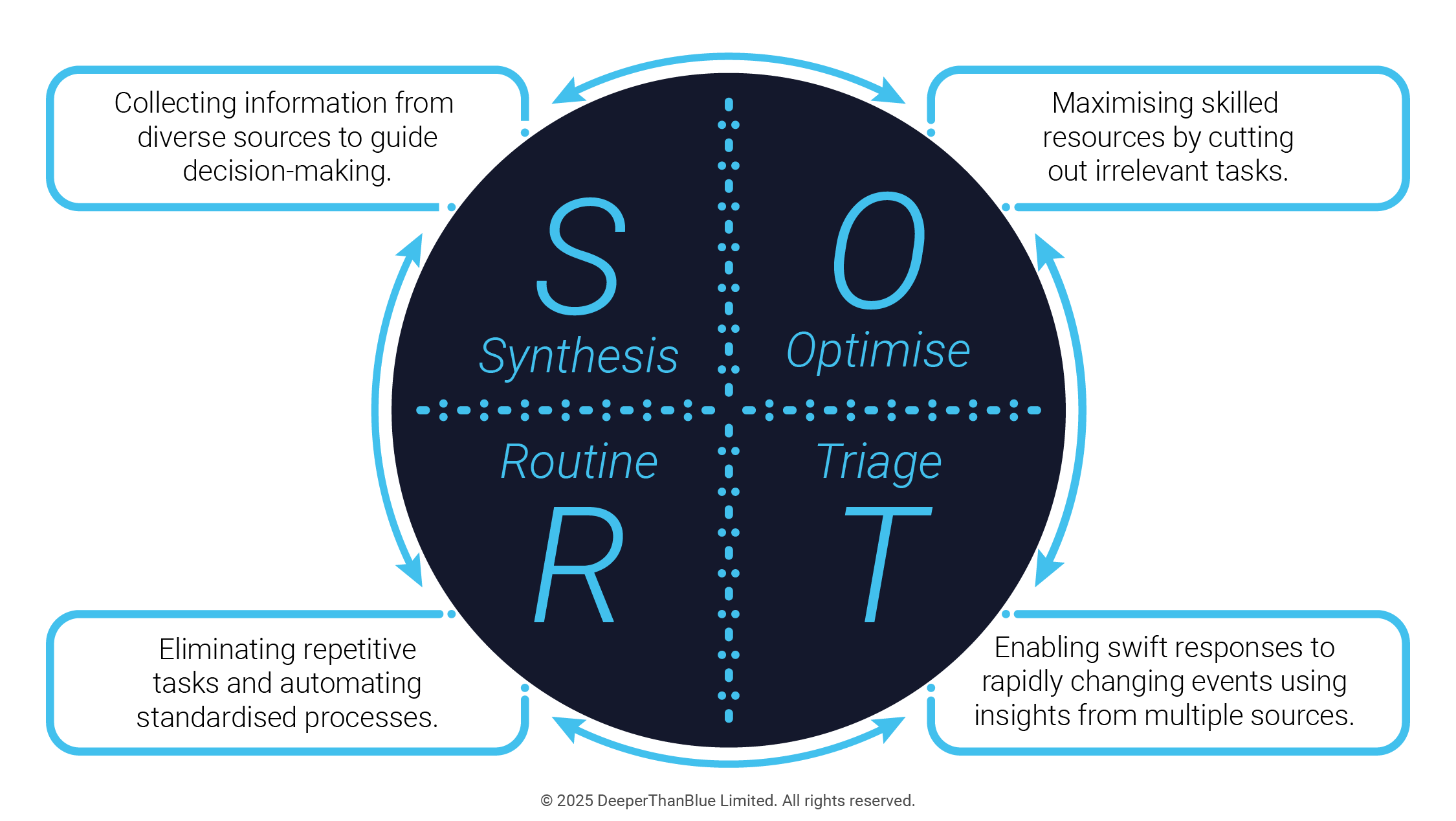
At DeeperThanBlue, we use SORT as a pragmatic lens for identifying and delivering AI use cases:
Synthesise
This closely mirrors The Curator and The Re-packager. It’s about consolidating fragmented knowledge, documents and data sources into usable intelligence. AI becomes the connective layer between institutional memory and real-time insight — enabling better decisions, faster responses and improved customer experience.
Optimise
Aligned with The Optimizer and The Supervisor, this is where AI improves decision-making, workflow efficiency and operational consistency. It enhances productivity not by replacing people, but by equipping them with better context, summarisation and predictive support.
Routine
This is where AI automates repetitive, rule-based or monotonous tasks — the operational grind that consumes time but creates limited strategic value. From drafting standard responses and generating documentation to processing straightforward requests, AI removes friction from everyday work.
This directly supports elements of The Optimizer and The Supplier archetypes. It’s often the fastest path to measurable ROI because it reduces manual effort at scale without requiring wholesale reinvention.
Triage
Here, AI classifies, prioritises and routes work intelligently — whether that’s customer enquiries, service tickets, claims, supplier communications or internal approvals. Triage capabilities enable organisations to respond faster and more accurately while ensuring human expertise is focused where it adds most value.
This aligns strongly with The Supervisor and The Supplier approaches described in the HBR piece.
What’s striking is how naturally these categories intersect. The difference lies in execution discipline.
This Isn’t Just for Global Giants
The HBR article references major players such as Elsevier, Duolingo, JPMorgan Chase, Spotify and Meta. These examples are compelling — but they can unintentionally reinforce the idea that transformational AI is reserved for those with deep R&D budgets.
It isn’t.
In reality, the proportional benefits available to mid-sized organisations can be just as significant. A regional insurer reducing claims handling time by 25% feels the impact as sharply as a multinational bank. A manufacturer automating routine documentation gains competitive advantage just as meaningfully as a global publisher enhancing content discovery.
The scale differs. The strategic leverage does not.
Generative AI does not demand hyperscale budgets. It demands clarity of purpose, structured data and disciplined implementation.
Moving Beyond Experimentation
One of the most important undertones in the HBR piece is the shift from experimentation to embedded value creation. Pilots and proofs of concept are useful — but they don’t transform operating models.
Too many organisations are stuck in the “demo phase”: internal chatbots with narrow scope, disconnected copilots, isolated productivity gains. Interesting, but not integrated.
The real opportunity lies in:
- Embedding AI into core workflows
- Aligning use cases to measurable business outcomes
- Governing data and risk from the outset
- Designing for scalability, not novelty
This is precisely the transition we help clients make.
From Use Case Discovery to Engineered Solutions
At DeeperThanBlue, our AI consultancy services focus on three practical stages:
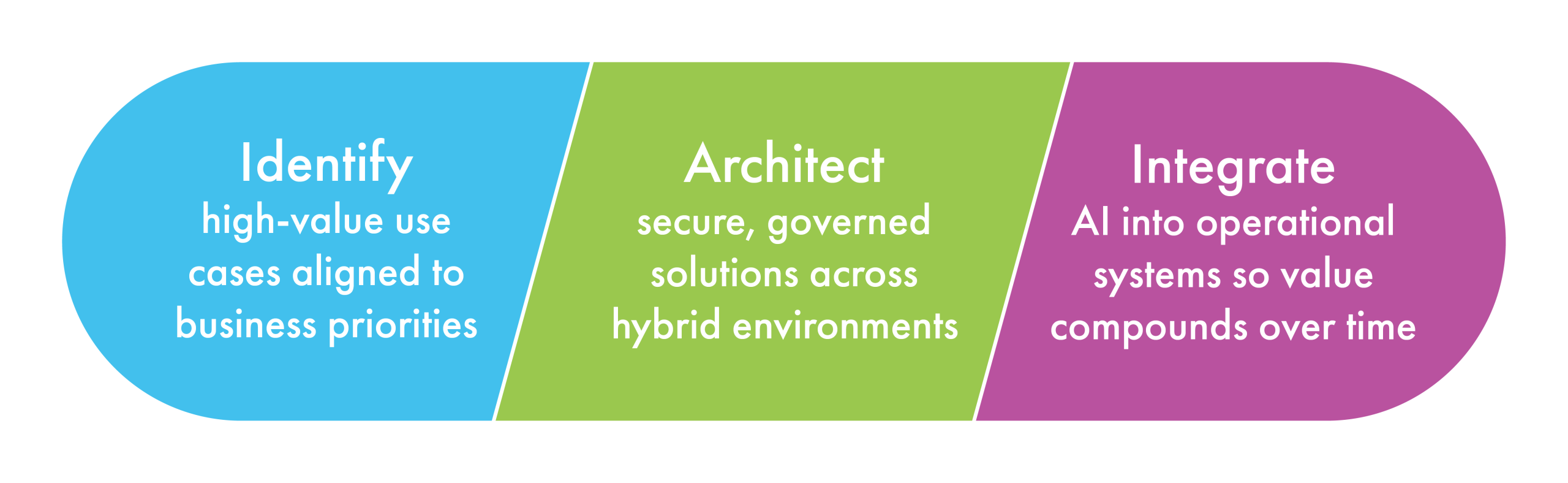
- Identifying high-value use cases aligned to business priorities
- Architecting secure, governed solutions across hybrid environments
- Integrating AI into operational systems so value compounds over time
Whether through knowledge synthesis, workflow optimisation, routine automation or intelligent triage, the objective remains consistent: measurable impact, not theoretical possibility.
The HBR article rightly argues that organisations should look for new ways to create value when deploying generative AI. We would add one more point:
Value creation is not a category. It is a capability.
And capabilities are built deliberately — through strategy, data readiness, governance and engineering expertise.
The organisations that succeed won’t be those who experimented the fastest. They will be those who operationalised most effectively.
The question isn’t whether generative AI can create value.
It’s whether your organisation is structured to capture it.
These might interest you
Crafting a Robust AI Strategy: A Practical Guide for Businesses
Introducing artificial intelligence into your organisation isn’t a case of finding new tech, flipping the switch and hoping for the Read MoreAgentic AI: What is it and How Can it Benefit Businesses?
Chatbots are evolving, drawing on advanced AI capabilities to become AI Agents – fully autonomous, sophisticated systems capable of advanced Read MoreAI For Business – Let’s get on with it…
AI is here to stay. You’re already using it whether you like it or not. So how do you use Read MoreAre you ready to find real value in AI?
If you would like help understanding what a roadmap for your organisations would look like or discussing how to move beyond pilot projects, please feel free to get in touch.
We can also help your organisation with increasing adoption of Microsoft Copilot.
+44 (0)114 399 2820
info@deeperthanblue.com
Get in touch