From AI Pilots to Agentic Reality
Google Cloud Next 2026 made one thing very clear: AI experimentation is over. This year’s event was Google’s most decisive statement yet that agentic AI is ready for real, large-scale enterprise deployment. And guess what? Google intends to provide the entire stack needed to make that happen.
During their Showcase event in Boston last week, Google made more than 260 announcements and framed the moment as a shift from isolated pilots to production-grade AI systems, backed by custom infrastructure, deeply integrated data platforms, and increasingly autonomous agents embedded across cloud services and Workspace. The message was consistent throughout: the future of cloud is agentic, and Google Cloud wants to own every layer of that future.
Take a breath
Before we take a deeper look into some of the Google announcements, it’s probably worth pinning DeeperThanBlue’s colours to the mast. Yes, we’re a Google Cloud partner, and will happily help large enterprises unleash the full power of Agentic AI on their business processes. But we’re also realists. We recognise that there are many thousands of businesses out there for whom the wholesale shift to Agentic AI is not realistic. For these businesses, the place to start is building a robust AI strategy.
For now, though, let’s take a deeper look into the exciting news from Google…
From tools to operating model
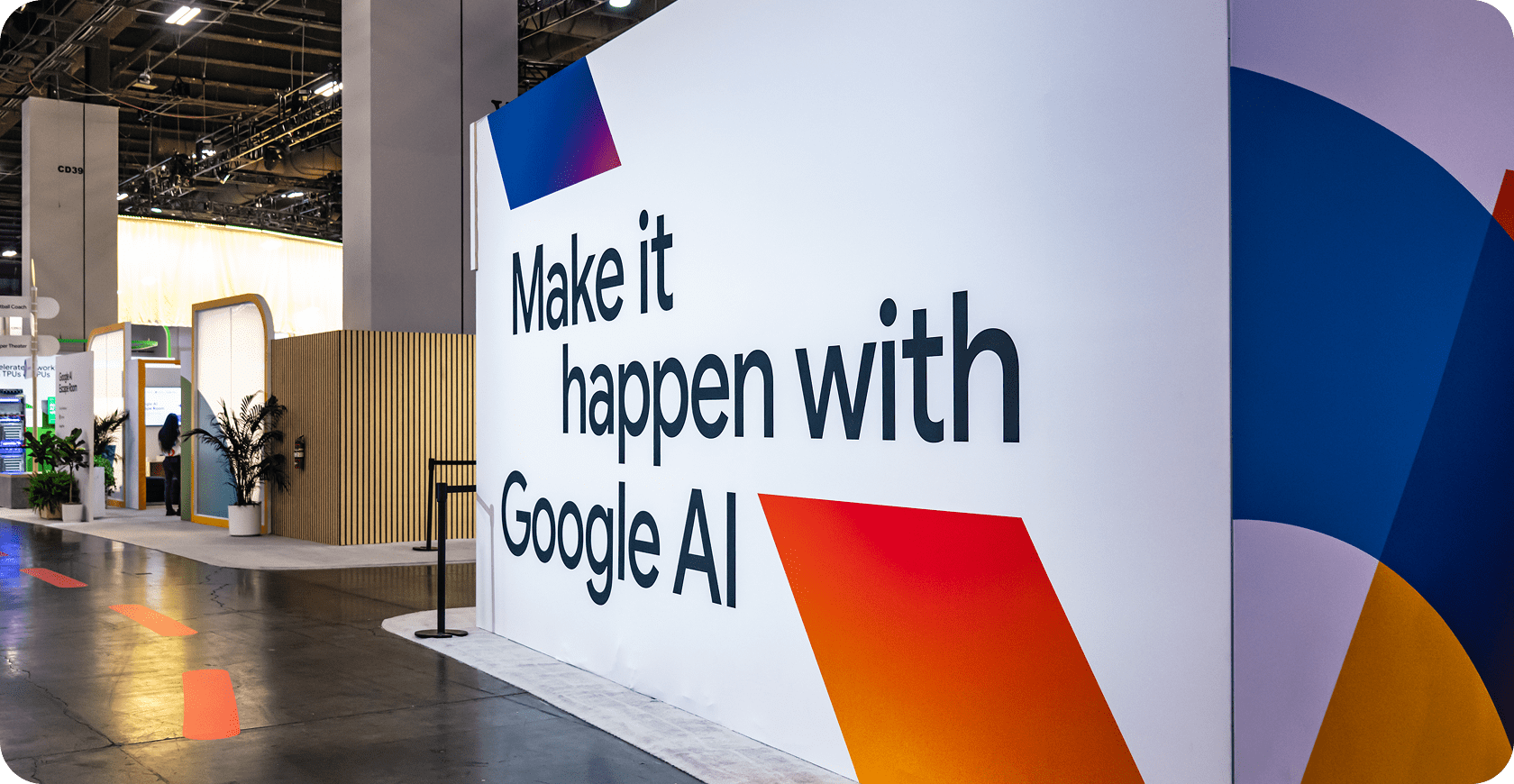
The dominant theme at Next 2026 was Google’s ambition to become the full‑stack platform for enterprise AI. Models, infrastructure, developer tooling, data, security, and productivity applications were all presented as part of a single, connected operating model rather than standalone products.
Google highlighted that nearly 75% of Cloud customers are already using its AI products, with token consumption growing rapidly. It was argued that this was evidence that AI workloads are moving into core business processes. Rather than pitching AI as something for experimentation, Google positioned it as something to run businesses on.
This framing matters. It positions AI agents not as features, but as long-lived digital workers that need governance, observability, security, and performance guarantees; concepts CIOs and CTOs understand well.
Gemini Enterprise Agent Platform: the headline launch
The most significant single announcement was the Gemini Enterprise Agent Platform, which Google described as an end‑to‑end environment for building, deploying, and managing AI agents at scale.
The platform brings together access to multiple frontier models (including Gemini 3.1 Pro, Gemini 3.1 Flash Image, Lyria 3, and Anthropic’s Claude Opus 4.7) with tooling designed for orchestration, evaluation, and lifecycle management. The emphasis was not on model novelty alone, but on how enterprises can reliably turn models into governed, production-ready agents.
Just as importantly, Google leaned into openness. By supporting both Google and third‑party models, it signalled an attempt to differentiate from more vertically locked-in competitors, positioning itself as a platform rather than a walled garden.
Infrastructure built for agents, not demos
Agentic systems are only as good as the infrastructure underneath them, and Google used Next 2026 to showcase major investments here as well.
The introduction of 8th‑generation TPUs, split between training‑optimised and inference‑optimised variants, was positioned as a key enabler for running large agent fleets efficiently. These chips were paired with broader advances in networking, memory, and cluster orchestration, all aimed at lowering latency, increasing throughput, and improving cost predictability for AI workloads.
This is a familiar but important Google Cloud story: pairing frontier models with bespoke silicon and infrastructure. The difference in 2026 is that this stack is no longer described as experimental. It’s being marketed as enterprise‑ready by default.
Agentic Data Cloud and enterprise control
Data remains the hardest part of enterprise AI, and Google acknowledged this directly with its “Agentic Data Cloud” narrative.
Rather than pushing customers to move data before they can do anything useful with it, Google focused on enabling agents to work across data where it already lives. This approach aims to reduce time‑to‑value while respecting existing architectures, compliance requirements, and ownership boundaries.
Security and governance featured heavily alongside this message. Expanded integrations with partners like Wiz, stronger policy controls, and improved observability were positioned as essential foundations for deploying agents safely at scale, especially in regulated environments.
The implication was clear: autonomous agents without governance are a risk; governed agents are a competitive advantage.
AI moves into everyday work
Next 2026 wasn’t just about platforms and infrastructure. Google also showed how agentic AI is being embedded directly into day‑to‑day work through Google Workspace.
Updates included smarter document creation and summarisation, more capable Gemini features in Sheets, meeting assistance that goes beyond note‑taking, and broader “work management” capabilities designed to automate repetitive tasks. While less technically ambitious than the agent platform announcements, these features matter because they demonstrate AI delivering visible productivity gains to non‑technical users.
Together, they reinforce the idea that AI agents are not just for developers—they are becoming part of how work gets done across the organisation.
A competitive statement, not just a product launch
Stepping back, Google Cloud Next 2026 felt less like a roadmap update and more like a strategic declaration.
Industry coverage noted the confidence with which Google positioned its cloud business: a serious challenger to both AWS and Microsoft. No longer a comeback story but a contender with clear momentum. By combining strong models, custom silicon, an open ecosystem, and deep integration across data and productivity tools, Google is betting that enterprises want fewer fragmented AI solutions and more cohesive platforms.
Whether this strategy succeeds will depend on execution, but the intent is unmistakable.
Final takeaway
Google Cloud Next 2026 sent a simple, powerful message: AI is no longer an experiment; it’s an operating model.
By centring the event on agentic systems, enterprise governance, and infrastructure purpose‑built for scale, Google made its case that the future of cloud is agents plus data, running on custom hardware, managed end to end. For organisations moving from AI ambition to AI reality, that’s a proposition worth paying attention to.
I will, however, sign off by reminding you that there is still a long way to go for smaller businesses (even some large businesses) before they will be able to introduce fully agentic systems, and DeeperThanBlue is able to help them on their way.
These might interest you
If you are ready to start your AI journey, or are already on your way, DeeperThanBlue can help you move to the next stage.
+44 (0)114 399 2820
info@deeperthanblue.com
Get in touch