Let’s be blunt: clusters are meant to bring order, performance, and resilience to your cloud environment. But in reality? They can just as easily turn into a tangled, over-engineered, under-optimised clusterf**k of confusion if left unchecked.
What starts as a sensible architecture decision – thoughtfully grouped nodes which allow improved scalability and availability – can spiral into something that’s expensive, opaque, and fragile. If that sounds uncomfortably familiar, you’re not alone.
When Good Clusters Go Bad
Clusters don’t become problematic overnight. The rot tends to creep in gradually. It is often disguised as “just one more change” or “we’ll tidy that up later”, and before long, you’re left with something nobody fully understands. Nobody wants to unpick the mess for fear of breaking something or (worse still) upsetting the in-house ‘expert’ whose pet project this originally was.
Here’s where things typically go sideways:
1. Over-Provisioning (aka Paying for Stuff You Don’t Need)
Clusters are often scaled “just in case”, especially in environments where performance matters. The result? Idle nodes burning through budget like there’s no tomorrow. In reality, you’re wasting your cloud spend (someone is always watching that bottom line), you face poor resource utilisation (what else could that computing power be used for?) and there is virtually no visibility into what is actually needed.
2. Under-Provisioning (aka Everything’s on Fire)
The flip side is just as painful. Clusters that aren’t scaled appropriately lead to bottlenecks, slow performance, and unhappy users. This leads to slow or failing applications, poor customer service and tech teams engaged in reactive firefighting rather than proactive optimisation.
3. Misconfigured Load Balancing
Load balancing should be the unsung hero of your cluster. When it’s misconfigured, it becomes the villain. Workloads are unevenly distributed, some nodes are overloaded while others sit idle, and there is increased risk of systems failure.
4. Fragile High Availability Setups
High availability (HA) is often assumed rather than tested. Many organisations discover their failover doesn’t work, but only when it’s far too late. A lack of clarity might mean that single points of failure are hiding in plain sight and that system resilience is inadequate under real-world conditions. Node failures lead to unnecessary downtime.
5. Cluster Sprawl
Multiple clusters across environments (dev, test, prod, regions, teams) can quickly become unmanageable, with clusters spun up without reference to the overall architecture as it feels like the quickest and cleanest solution. However, in the long run this leads to operational complexity, inconsistent configurations and gaping holes on governance and security.
6. Kubernetes Chaos
Platforms like Kubernetes are incredibly powerful—but they’re not forgiving. Poorly managed clusters can become a labyrinth of misconfigured services, pods, and policies. Organisations can be faced with a lack of standardisation, challenges in diagnosing problems and teams too afraid to open the box in case everything just falls apart.
Can you afford to take this risk?
Let’s not sugar-coat it. A poorly managed cluster environment isn’t just untidy. It’s expensive and it’s risky. Would you be happy to stand in front of the Board and explain away:
- Financial drain: Overspending on infrastructure that isn’t delivering value
- Operational inefficiency: Teams spending more time troubleshooting than innovating
- Increased risk: Higher likelihood of outages and service degradation
- Slower delivery: Complexity becomes a blocker to change
In short: when your cluster stops being an enabler and starts being a liability, you’re going to be faced with some difficult decisions.
However, you don’t have to tackle this on your own. With a structured plan and a reliable partner in your corner, you’re ready to act proactively and bask in the glory of a job well done. You are ready, aren’t you?
So… How Do You Sort Your Sh*t Out?
What you need is a structured, pragmatic approach. Six steps that will make all the difference.
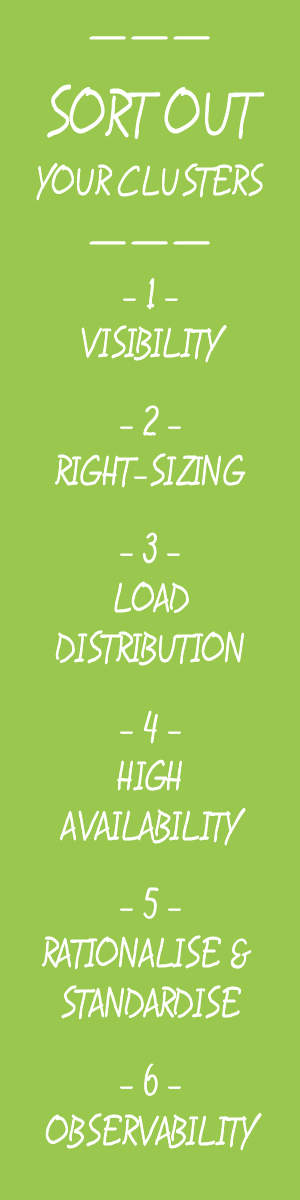 1. Get Visibility (No More Guesswork)
You can’t fix what you can’t see.
- Audit cluster usage, performance, and costs
- Identify underutilised and overburdened nodes
- Map dependencies across workloads
2. Right-Size Everything
Balance is the goal—not excess.
- Scale nodes based on actual demand
- Introduce auto-scaling where appropriate
- Align infrastructure with real workloads
3. Fix Load Distribution
Make sure the workload is actually, well, distributed.
- Review and optimise load balancing configurations
- Ensure even utilisation across nodes
- Remove bottlenecks
4. Test High Availability Properly
Don’t assume failover works. Test it and prove it.
- Simulate node failures
- Validate recovery processes
- Eliminate hidden single points of failure
5. Rationalise and Standardise
Less chaos, more control.
- Consolidate unnecessary clusters
- Standardise configurations across environments
- Implement governance and best practices
6. Bring Observability Into the Mix
Monitoring isn’t enough. What you really need is insight.
- Implement real-time observability tools, like IBM Instana
- Track performance, costs, and anomalies
- Enable proactive and automatic issue resolution
Where DeeperThanBlue Comes In
This is exactly the kind of mess DeeperThanBlue thrives on sorting out.
We actually enjoy getting under the hood and making thing run smoothly. We don’t just look at clusters in isolation, we look at how they support your business goals. That means aligning performance, cost, and resilience with what matters to you.
Here’s how we help:
Cloud Assessment & Optimisation
We audit your existing cluster environments to identify inefficiencies, risks, and opportunities for improvement. We make sure that the cloud environment is the best one for you and recommend alternative approaches where appropriate.
Architecture Review & Redesign
Whether it’s public, private, or hybrid cloud, we design cluster strategies that are fit for purpose—not over-engineered for the sake of it.
Kubernetes & Container Expertise
As a Kubernetes Certified Service Provider, we bring structure to Kubernetes environments, making them manageable, scalable, and (crucially) understandable.
Cost Optimisation
We identify where you’re potentially overspending and put practical steps in place to reduce waste without compromising performance.
Ongoing Monitoring & Support
We don’t just fix things and disappear. We provide the observability and support needed to keep your clusters running smoothly. We can hang around post improvement if you value another opinion and need someone to lean on with one of our support agreements.
Final Thought
Clusters are powerful. But without the right strategy, governance, and visibility, they can turn into a ClusterF**k faster than you’d expect.
The good news? It’s fixable.
And once it’s sorted, your cloud environment stops being a source of frustration. It starts delivering the performance, resilience, and efficiency it was meant to in the first place.
We’re sure you’d prefer to make that presentation to the Board, rather than the one where you’re making excuses for frailties that are out of your control.
These might interest you
Cloud Consulting Services
A vast amount becomes possible when you embrace technology, introduce new applications and solutions for your business and move forward Read MoreKubernetes Certified Service Provider
In today’s fast-paced digital landscape, businesses must embrace agility, scalability, and efficiency to stay ahead of the competition. As a Read MoreCloud Services
We specialise in cloud hosting and cloud migration. Whatever your existing legacy infrastructure or systems and whatever your current cloud Read MoreDon’t face your clusterf**k alone. We’re here for you!
You can’t predict when your clusters are going to turn on you, so don’t risk it any longer.
You can’t pick your family but you pick your cloud and Kubernetes partner.
Get in touch with DeeperThanBlue to help you configure your cloud architecture effectively.
+44 (0)114 399 2820
info@deeperthanblue.com
Get in touch